Interplanetary Vessel · Earth — Titan — Enceladus — Earth
Twelve people. Fifteen years. No rescue, and hours to ask Earth a question.
A ship you operate by procedure, not by reflex. Every gauge is fed by one causal model of the vessel; every warning names its price, and the few hard refusals name their reason; and the flight plan was flown in GMAT, NASA's open-source mission analysis tool, before it was ever flown here.
You sit at her consoles and run her for fifteen years. Every warning names its price and lets you do it anyway. There is no undo.
Four doors
02Not a navigation bar — four arguments you may choose to enter. Each owns its own figures, so a number appears on the page that is responsible for it and nowhere else.
Trajectory C2
5,519 dNine phases, one arrival. Why a Jupiter assist and not the direct route.
Read → 02 · The vesselThe ship
5,334 tMass along the hull, spin and g, power and heat, and what refuses to move.
Above → 04 · The recordThe book
v6.20Twelve chapters of the vessel's own documentation. Chapter I is free.
Read →The vessel
03One causal model drives the whole vessel. A lever moved in one bay moves the ship and another bay's numbers, because there is only one graph underneath and every console reads from it. Nothing rolls dice — every unpredictability is a deterministic process you can learn to read.
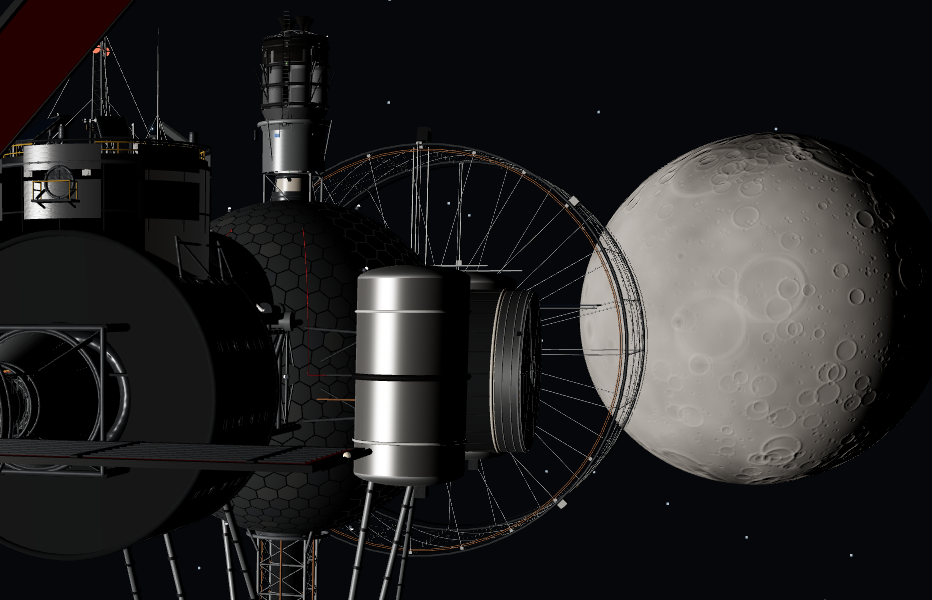
Every element in the mass ledger sums to the ledger's own TOTAL row, or this page does not build.
The fleet
04She carries craft, and the craft are how the science actually gets done. Nothing lands on Enceladus by accident: a plume transit is worked from the K-6, and Titan is flown rather than driven, because Titan has an atmosphere thick enough and gravity low enough that rotors are the cheapest way to move.
Enceladus
MET 2,720Plume transit · worked from K-6
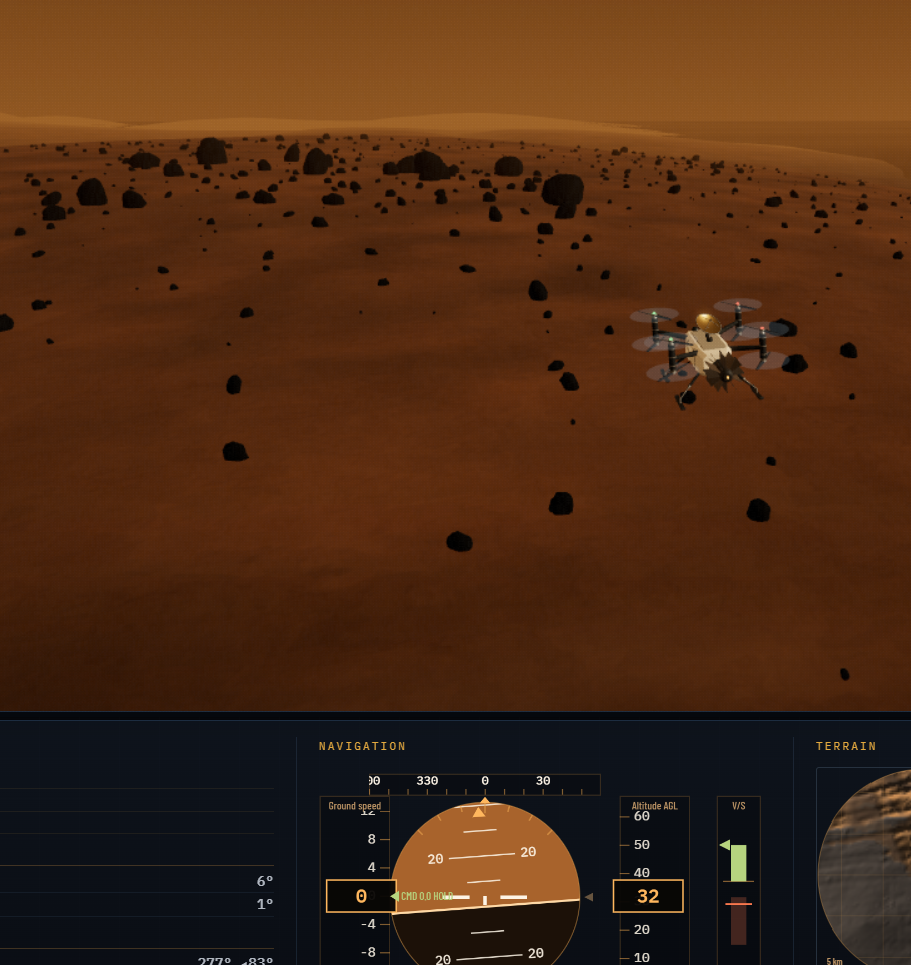
Titan
32 m AGLRotorcraft survey · flown, not driven
The console
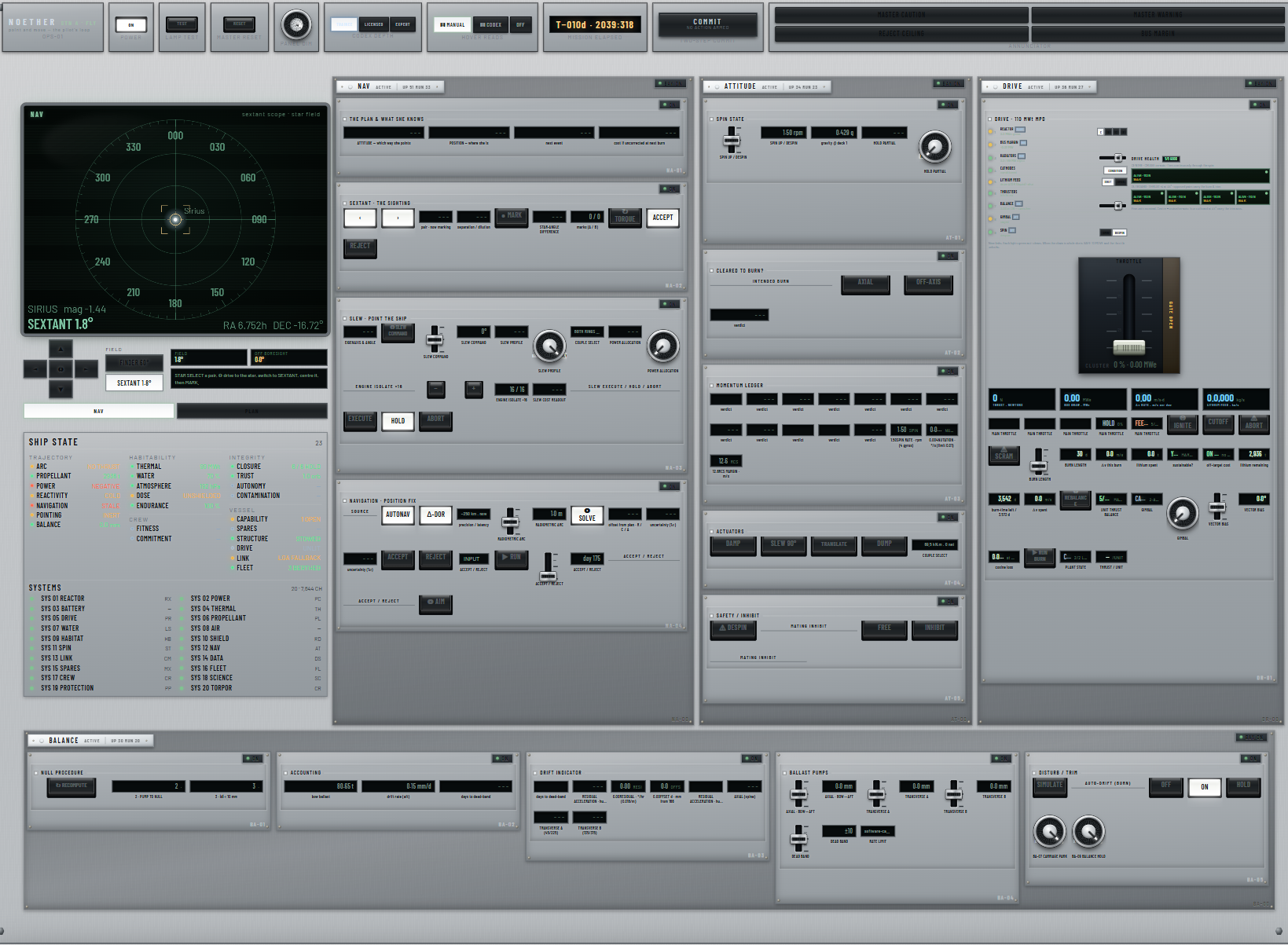
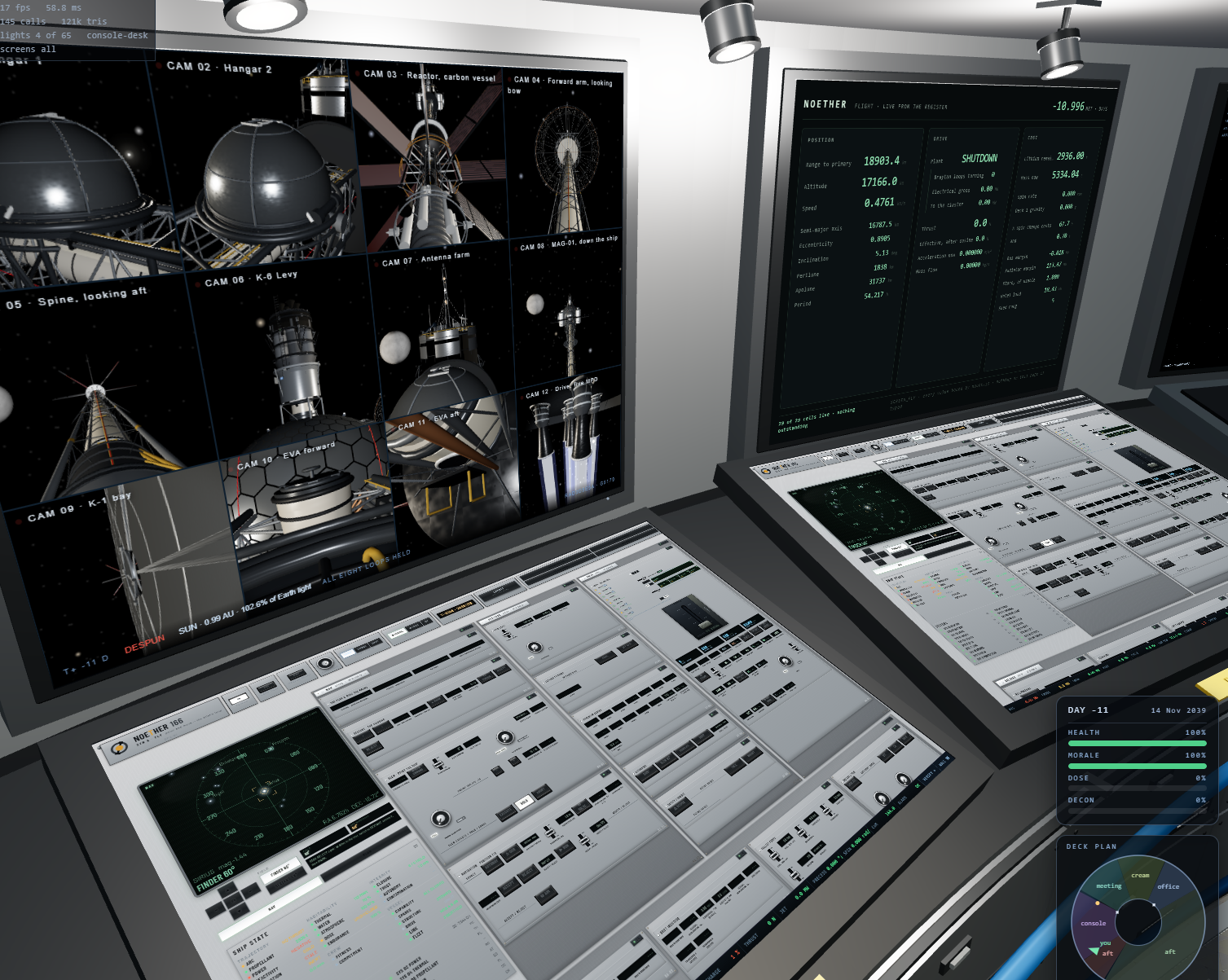
05This is the game: you sit here and run her. Live telemetry, the camera bank, the ship's state — every reading tied back to the same causal model as the vessel above.
The ship's book
06Twelve chapters — vessel, crew, mission, operations — written as the ship's own documentation rather than as marketing about a game. It is long, it is sourced throughout, and it is the fastest way to know whether this is for you.
When it opens
07The Steam page is in Steamworks and is not live yet. This is the action that will carry it; until the store page opens, the honest thing to offer is the book.
Send feedback
Your email client should have opened with the message ready to send. If nothing opened, email us directly at contact@noether166.com.